Anxious Attachment: Signs, Triggers, and Nervous System Patterns
TABLE OF CONTENTS
What Is Anxious Attachment?
Signs of Anxious Attachment in Adults
How Anxious Attachment Develops
What Happens in the Nervous System
Anxious Attachment in Dating & Relationships
Common Triggers for Anxious Attachment
Protest Behaviors Explained
Can Anxious Attachment Change?
How to Regulate Anxious Attachment
When to Seek Support
Anxious Attachment Workbook (Structured Practice)
Frequently Asked Questions
Key Takeaways
Anxious attachment reflects hyperactivation of the attachment system; the nervous system moves into urgency when connection feels uncertain.
Common signs include reassurance-seeking, overanalyzing communication, fear of abandonment, and distress when intimacy shifts.
These patterns often develop in response to inconsistent or unpredictable early connection.
Anxious attachment is not a personality flaw. it is a conditioned nervous system response.
Insight alone does not change the pattern. Regulation and repeated secure behaviors do.


Anxious attachment isn’t about being “too emotional.”
It’s a nervous system that learned early on that love can feel uncertain, and uncertainty feels unsafe.
At its core, anxious attachment is hyperactivation of the attachment system. When connection shifts, even slightly, the body reacts before the mind can reason. You may crave reassurance, overanalyze tone and timing, or feel a surge of urgency when someone pulls away. This isn’t weakness. It’s protection.
Originally described by John Bowlby and expanded by Mary Ainsworth, attachment theory explains how inconsistent caregiving can condition the nervous system to scan for loss. That adaptation can follow us into adulthood, especially in romantic relationships where closeness matters most.
Anxious attachment isn’t just psychological. It’s physiological. When connection feels threatened, the body shifts into fight-or-flight. The spiral of overthinking, the tightening chest, the need to restore contact—these are stress responses aimed at safety.
This isn’t your personality. It’s a learned protection pattern. And with regulation and consistent safety, it can change.
Common Signs of Anxious Attachment
Anxious attachment does not always look dramatic. Sometimes it looks like caring a lot. Sometimes it looks like being “the thoughtful one.” Sometimes it looks like lying awake at 1:12 a.m. rereading a text that was probably fine.
The pattern is less about behavior and more about activation. What does your body do when connection feels uncertain?
Here are the most common signs.
Emotional Signs
Strong fear of abandonment, even in stable relationships
Intense relief when reassured
Quick emotional shifts based on closeness or distance
Heightened sensitivity to conflict
Feeling “too much” or worried you are too much
The emotional tone is often urgency. Love feels precious and fragile
at the same time.
Behavioral Signs
Craving frequent contact and fast replies
Sending follow up texts when there is no response
Overexplaining feelings to prevent misunderstanding
Seeking reassurance repeatedly
Difficulty calming down after an argument
None of these behaviors are random. They are attempts to restore connection. When your system feels distance, it moves toward.
Cognitive Patterns
Overanalyzing tone, punctuation, or response time
Assuming the worst when communication slows
Replaying conversations in your head
Planning how to prevent someone from leaving
Hyperfocus on relational cues
Your mind becomes a detective. It searches for clues. It builds stories to explain the silence. And once the story starts, it can run.
If you recognize yourself in this list, take a breath. These signs are not character flaws. They are signals of a nervous system that learned closeness can disappear. The body does not want to be caught off guard again.
And when the body feels threatened, it gets loud.
How Anxious Attachment Develops
Anxious attachment usually begins in environments where love was present, but not always predictable.
A caregiver may have been warm and affectionate at times, then distracted, overwhelmed, or emotionally unavailable at others. For a child, that inconsistency is confusing. Connection feels good. But it does not always feel stable.
The developing nervous system adapts.
Attachment theory showed that children organize their behavior around maintaining closeness to caregivers. When care is inconsistent, the attachment system increases signaling. The child protests more. Clings more. Monitors more closely.
Not because they are dramatic. Because proximity equals survival.
Early Relational Inconsistency
In some homes, affection came and went depending on stress levels, work demands, mental health, or family conflict. A parent might have loved deeply but struggled with their own regulation. The child learned that closeness could shift without warning.
So the system stayed alert.
Emotional Attunement Gaps
Emotional attunement means having your feelings noticed and responded to with consistency. When attunement is inconsistent, a child may amplify emotion to be seen. If sadness is missed, it gets louder. If fear is minimized, it intensifies.
Over time, emotional expression becomes charged with urgency.
Nervous System Conditioning
This is where the body comes in.
Repeated relational unpredictability sensitizes the stress response. The brain begins to associate small cues of distance with potential loss. Neural pathways strengthen around vigilance and activation.
Research in attachment and interpersonal neurobiology suggests that early relational experiences shape how the autonomic nervous system responds to connection and separation later in life. Patterns become embodied. They become automatic.
And yet, this is important. Most caregivers are not intentionally inconsistent. They are human. They carry their own histories, stressors, and attachment patterns. Anxious attachment is not about blame. It is about adaptation.
The child’s body did something brilliant. It turned up the volume to stay connected. The problem is not that the strategy formed. The problem is that the strategy keeps firing long after the environment has changed.
What Happens in the Body
This is the part most people skip.
Anxious attachment is not just a story you tell yourself about love. It is a physiological event. It is activation. It is electricity moving through the body when connection feels uncertain.
When someone pulls back, delays a reply, changes tone, or seems distracted, your nervous system can register threat. Not logical threat. Relational threat. And the body does not always know the difference.
The attachment system is deeply wired into survival circuits. Research on stress physiology and autonomic regulation, including the work of Stephen Porges, helps explain why connection and safety are intertwined in the body. When safety cues decrease, the sympathetic nervous system increases.
This is hyperactivation.
Hyperactivation
Hyperactivation is a fight or flight dominant state. Your system mobilizes to restore closeness.
You may feel:
A surge of energy
Restlessness
An urgent need to fix the situation
A spike of anxiety that feels bigger than the moment
Your body is not trying to embarrass you. It is trying to secure attachment.
Physical Sensations
This pattern is not subtle.
Common body cues include:
Tightness in the chest
Racing heart
Shallow breathing
Heat in the face
A drop in the stomach
Trouble sleeping after conflict
You might tell yourself to calm down. But the body is already moving.
Sometimes it feels almost spiritual. Like a cord between you and the other person just snapped. Like something sacred is at risk. The longing can feel existential. That makes sense. Attachment is wired into our need for belonging, and belonging touches the deepest layers of identity.
Rumination and Urgency
When the nervous system activates, the mind follows.
Thoughts loop. You replay conversations. You scan for what you did wrong. You draft texts in your head. You imagine outcomes that have not happened.
The mind is trying to solve what the body feels.
And here is the hard truth. The urgency you feel to reach out, to explain, to secure reassurance, will temporarily soothe the activation. That relief reinforces the cycle. The nervous system learns that protest reduces pain.
So it protests again next time.
Why Distance Feels So Intense
For someone with anxious attachment, distance does not feel neutral. It feels destabilizing. Connection equals regulation. When connection feels shaky, the body loses one of its external anchors.
This is why simple advice like “just don’t overthink” rarely works. You are not fighting a thought pattern alone. You are working with an activated nervous system that believes something essential is slipping away.
And underneath all of it, often, is a quiet spiritual ache.
Will I be chosen?
Will I be kept?
Am I safe to stay?
Those questions do not live only in the mind. They live in the body.
The good news is this. The nervous system can learn new responses. Activation can soften. Urgency can slow. But it starts with understanding that what you are feeling is not weakness.
It is wiring.
And wiring can change.
Anxious Attachment Triggers
Triggers are not random.
They are specific moments when your nervous system interprets something as a threat to connection. The reaction may look outsized from the outside. Inside your body, it feels immediate and real.
A trigger is not weakness. It is a stored association.
Here are some of the most common ones.
Delayed text responses
Short or neutral tone shifts
Canceled plans
Unclear relationship status
Reduced affection or attention
A partner needing space
Social media activity that feels ambiguous
Notice how subtle many of these are. None of them guarantee rejection. But for a sensitized attachment system, ambiguity can feel like danger.
Why Triggers Feel Bigger Than the Moment
When you are triggered, you are not only reacting to the present situation. You are reacting to accumulated memory. The nervous system stores patterns. If past experiences taught your body that distance precedes loss, then even small gaps can activate alarm. The reaction is fast because it is protective.
This is why you might think, “I know I am overreacting,” while your heart is racing anyway. The thinking brain and the survival brain are not always in agreement.
There is also something deeply human here. We are wired for belonging. Social connection regulates stress hormones, heart rate, even immune function. When connection feels unstable, your body reads it as significant.
And sometimes, beneath the surface trigger, there is a deeper spiritual longing.
Do I matter here?
Am I secure here?
Will I be left?
Triggers light up those questions. Healing is not about eliminating triggers entirely. It is about increasing your capacity to stay steady when they arise. It is about teaching your nervous system that not every pause equals abandonment.
That work is practical. Repetitive. Sometimes uncomfortable.
And it is possible.
Can Anxious Attachment Change?
Yes.
Not overnight. Not through insight alone. But yes.
A lot of people can explain their attachment style in perfect detail. They can name their childhood patterns. They can predict their reactions. And then a partner takes six hours to respond and the spiral still happens.
Because awareness is cognitive.
Attachment is physiological.
You do not think your way into security. You regulate your way there.
Secure attachment develops when the nervous system experiences repeated safety without needing to escalate. When distance does not automatically equal danger. When conflict does not automatically equal loss.
This is where neuroplasticity matters. The brain and nervous system can form new pathways through repeated, corrective experiences. Not dramatic breakthroughs. Consistent regulation.
Security is built through:
Pausing before protest
Learning to self soothe when activated
Communicating needs clearly instead of indirectly
Tolerating uncertainty without immediate action
Choosing partners who respond with consistency
At first, this can feel unnatural. Almost wrong. If your body is used to urgency, calm can feel unfamiliar. Even boring.
Stay with it.
Insight Is Not Enough
Understanding why you feel anxious in relationships can bring compassion. That matters.
But insight does not automatically retrain the sympathetic response.
Regulation does.
That means working with your body directly. Slowing breathing. Grounding through sensation. Naming activation in real time. Tracking triggers instead of reacting to them instantly.
It is simple work. Not easy. But simple.
And over time, the urgency softens.
How to Start Healing
If you are wondering where to begin, start small.
Notice what happens in your body when you feel distance
Track your most common triggers
Delay reactive behaviors by even five minutes
Practice expressing needs without accusation
Build a life that does not rely on one person for all regulation
You are not trying to eliminate your need for connection. That need is sacred. You are building the capacity to stay steady inside it.
Security is not becoming less loving. It is becoming less afraid.
And here is the truth that does not get said enough. Anxious attachment often carries enormous depth, loyalty, and emotional intelligence. When regulated, those qualities become strengths instead of sources of pain.
You do not have to become someone else.
You are refining your nervous system.
Start With Structure
If you recognize yourself in this pattern and you’re ready to work with it directly, structure matters.
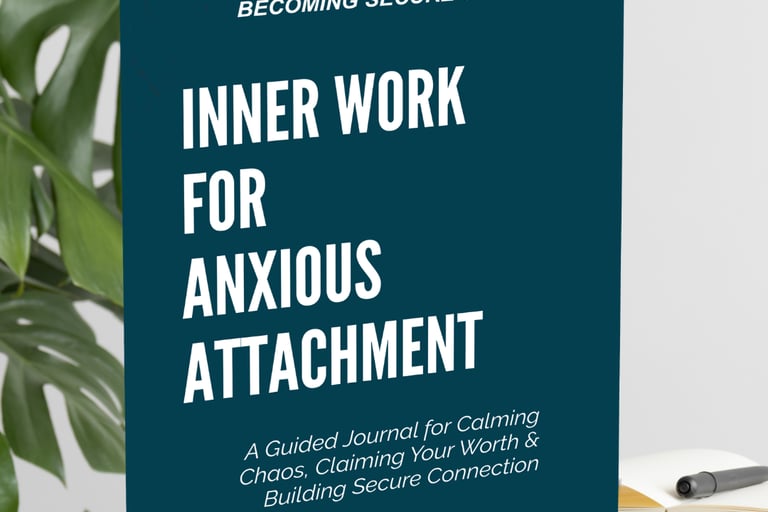
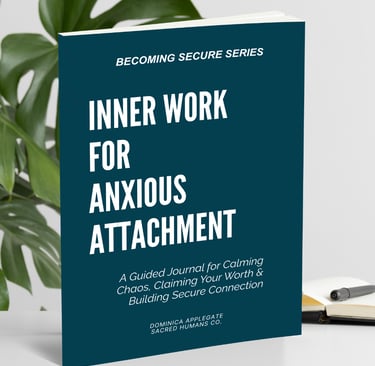
The Inner Healing for Anxious Attachment Workbook is available as both a downloadable digital edition and a softcover print version - designed to guide you step by step through applied regulation work.
Inside, you’ll learn how to:
Map your specific attachment triggers
Identify hyperactivation patterns in your body
Interrupt protest cycles before they escalate
Practice secure communication scripts
Build consistent weekly regulation routines
This is not passive reading. It’s structured nervous system practice.
Clear. Practical. Repeatable.
Security is not personality. It is regulation. And regulation can be practiced.
Begin the Workbook (Digital Download or Softcover)




Attachment Blueprint
Articles
Anxious Attachment
Avoidant Attachment
Fearful-Avoidant
© 2025. All rights reserved.
EXPLORE
About
Workbook
Contact
Quiz