
Anxious Preoccupied Attachment Style: Signs, Triggers & How to Heal
Anxious preoccupied attachment style is an insecure attachment pattern rooted in fear of abandonment, hypervigilance in relationships, and a deep need for reassurance. If you’ve ever found yourself overanalyzing a text, panicking when someone pulls away, or feeling like you need constant confirmation that you’re loved, this might be your pattern.
It’s not weakness.
It’s wiring.
Anxious attachment often forms in childhood when connection felt inconsistent, unpredictable, or emotionally unsafe. The nervous system learned to stay alert. To scan. To cling. To prepare for loss before it happened.
And that pattern doesn’t just disappear because you understand it logically.
As adults, people with anxious preoccupied attachment may feel deeply in love one moment and deeply afraid the next. They crave intimacy. They long for closeness. But underneath it all is a pulse of anxiety… a quiet (or loud) question:
Are they going to leave?
This article explores what anxious preoccupied attachment style really is, how it develops, how it shows up in adult relationships, and, most importantly, how healing is possible.
Because anxious attachment isn’t a personality flaw.
It’s an adaptation.
And adaptations can change.
What Is Anxious Preoccupied Attachment Style?
Anxious preoccupied attachment style is one of the insecure attachment patterns identified in attachment theory. At its core, it is marked by fear of abandonment, heightened emotional sensitivity in relationships, and a strong need for reassurance.
But let’s make this real.
It’s checking your phone again.
It’s rereading the message.
It’s feeling your stomach drop when someone’s tone shifts slightly.
It’s wanting closeness so deeply it almost aches, and then panicking that the very thing you want might disappear.
People with anxious preoccupied attachment often:
Crave emotional intimacy
Fear rejection or abandonment
Struggle to self-soothe when connection feels uncertain
Overanalyze relational cues
Feel responsible for keeping the relationship stable
They may appear “clingy” or “too much” to others. But underneath that behavior is not manipulation. It’s fear. A nervous system that learned early on that connection was unpredictable.
Anxious attachment isn’t about loving too hard.
It’s about feeling unsafe when love feels unstable.
And that insecurity can show up even in healthy relationships, especially when the nervous system perceives threat, whether real or imagined.
The good news? This pattern is not a life sentence. It’s learned. And what is learned can be reshaped.
What Causes Anxious Attachment?
Anxious preoccupied attachment doesn’t develop out of nowhere.
It forms in childhood, often in environments where caregiving was inconsistent, emotionally unavailable, or unpredictable. A parent might have been loving one day and distant the next. Present physically, but not emotionally. Overwhelmed. Depressed. Distracted. Or needing the child to meet their emotional needs instead.
To a developing nervous system, inconsistency feels dangerous.
A child depends entirely on their caregiver for survival. If care is inconsistent, the child adapts. The brain and body shift into hyper-alert mode. They scan for signs of disconnection. They cling harder. They protest louder. Not because they’re dramatic, but because proximity equals safety.
This is where anxious attachment begins.
The nervous system becomes wired for vigilance. It learns:
Stay close. Don’t lose them. Monitor everything.
And that wiring doesn’t magically disappear at age eighteen.
As adults, those early adaptations show up in romantic relationships. The brain interprets a delayed text as potential abandonment. A partner needing space feels like rejection. Conflict feels catastrophic.
This isn’t immaturity.
It’s conditioning.
When a child repeatedly experiences emotional unpredictability, their body stores that instability. Over time, the attachment system becomes hyperactivated, meaning it reacts quickly and intensely to perceived relational threats.
And here’s the important part:
Anxious attachment is not a character flaw.
It is a survival strategy that once made sense.
The work of healing isn’t about shaming the strategy.
It’s about teaching the nervous system that connection can be steady. That space doesn’t equal loss. That you can survive discomfort without collapsing into fear.
That’s where the shift begins.
Signs of Anxious Preoccupied Attachment in Adults
Anxious preoccupied attachment in adults doesn’t always look dramatic from the outside. Often, it’s internal. Quiet. A constant hum beneath the surface.
But if you slow down and look honestly, certain patterns tend to repeat.
You may notice:
A strong need for reassurance from your partner
Anxiety when texts or calls go unanswered
Fear of rejection, even without clear evidence
Jealousy that feels hard to regulate
Difficulty calming yourself when conflict arises
Overanalyzing tone, facial expressions, or subtle shifts
Feeling responsible for keeping the relationship intact
Low self-worth tied closely to relational approval
There is often a deep longing for intimacy, not casual connection, but closeness. Real closeness. The kind where you feel chosen.
And yet, the closer you get, the more your nervous system scans for signs that it could disappear.
You may find yourself thinking:
“They don’t really love me.”
“They’re going to leave eventually.”
“I need to do more so they don’t lose interest.”
The body tightens. The mind races. The story escalates.
Anxious attachment isn’t just emotional sensitivity. It’s hyperactivation of the attachment system — meaning your nervous system reacts quickly and intensely to perceived relational threat.
And perceived is important here.
Because often, the reaction is bigger than the moment itself.
That’s not because you’re irrational.
It’s because your system learned early on that closeness wasn’t entirely safe.
Anxious Attachment in Relationships
In relationships, anxious preoccupied attachment often creates a painful paradox.
You want closeness.
You crave depth.
You long to merge.
But the very thing you want can activate fear.
People with anxious attachment tend to seek partners who feel magnetic - intense, exciting, emotionally charged. And many times, those partners lean avoidant. Emotionally unavailable. Independent. Hard to fully access.
This dynamic creates what’s often called the anxious–avoidant cycle.
The more the avoidant partner pulls back, the more the anxious partner reaches.
The more the anxious partner reaches, the more the avoidant partner feels overwhelmed and retreats.
It becomes a dance.
A push.
A pull.
A spiral.
And inside that spiral, the anxious partner often feels:
Desperate for reassurance.
Terrified of loss.
Frustrated at themselves for reacting so strongly.
Sometimes this shows up as protest behaviors… calling repeatedly, sending long emotional texts, creating conflict, testing the relationship unconsciously to see if it will hold.
Not because you want drama.
But because your nervous system is trying to restore proximity.
Here’s the part that’s hard to admit:
Anxious attachment can feel like love.
The intensity. The obsession. The emotional high and crash. It feels passionate.
But true secure attachment feels different.
It feels steady.
Calm.
Predictable.
And if you grew up with inconsistency, steadiness can feel unfamiliar or even boring at first.
That doesn’t mean you’re broken. It means your system was wired for volatility. The work isn’t to shame yourself for wanting connection.
The work is to build the internal security that allows you to experience closeness without collapsing into fear.
Common Anxious Attachment Triggers
If you identify with anxious preoccupied attachment, your reactions probably don’t feel random.
They feel immediate.
Sudden.
Almost automatic.
That’s because attachment activation happens fast, often before conscious thought catches up.
Here are some of the most common anxious attachment triggers in adults:
1. Delayed Responses
A text goes unanswered. A call isn’t returned. Logically, you know they might just be busy. But your body doesn’t care about logic.
Your chest tightens. Your mind starts scanning. The story builds quickly:
Something’s wrong.
They’re pulling away.
I did something.
This is hyperactivation - the attachment system moving into threat mode.
2. Emotional Distance
A partner seems distracted. Less affectionate. Quieter than usual. For someone with anxious attachment, emotional distance can feel like impending abandonment. Even if nothing has been said. Even if the shift is minor. The nervous system registers space as danger.
3. Relationship Conflict
Healthy conflict is part of intimacy. But if you grew up with instability, conflict may feel catastrophic.
You may hear:
“We need to talk.”
And your brain translates:
“This is the beginning of the end.”
The reaction is often bigger than the moment, because it’s wired to old experiences of unpredictability.
4. Partner Independence
When your partner makes new friends, invests in hobbies, or needs alone time, it can trigger insecurity.
The fear isn’t really about the hobby.
It’s about being replaced.
Anxious attachment often confuses independence with detachment.
5. Perceived Rejection
A shift in tone.
A missed invitation.
A subtle change in energy.
These moments can activate deep fears of not being enough.
And once the nervous system is activated, it searches for proof.
This is the pattern.
Not because you’re dramatic.
Because your attachment system learned to stay alert.
Why Awareness Alone Doesn’t Heal Anxious Attachment
This is where things get honest. You can know your attachment style.
You can read the books.
Take the quizzes.
Understand the theory.
And still feel your heart race when someone pulls away. Because insight lives in the mind. Attachment lives in the nervous system.
Anxious preoccupied attachment is not just a belief pattern. It’s a physiological one. When connection feels uncertain, your body shifts into survival mode - fight, flight, freeze, or cling.
You might tell yourself:
“I know I’m overreacting.”
And still feel unable to calm down.
That’s because the reaction is not purely cognitive. It’s embodied memory.
Healing anxious attachment requires more than awareness. It requires:
Learning to regulate before reacting
Creating new relational experiences that feel safe
Rewiring catastrophic thought loops
Practicing secure behaviors consistently
You’re not trying to “convince” yourself you’re safe. You’re teaching your nervous system what safety feels like. And that takes repetition.
It takes practice.
It takes moments where you pause instead of protest.
Where you breathe instead of spiral.
Where you allow space without collapsing into fear.
Awareness is the doorway.
Regulation is the work.
And secure attachment is something the body can learn… slowly, steadily, imperfectly.
How to Heal Anxious Preoccupied Attachment
Healing anxious preoccupied attachment is not about becoming less emotional.
It’s about becoming more regulated.
It’s about teaching your nervous system that connection can be steady, and that you can survive moments of distance without collapsing into fear.
This isn’t overnight work. It’s layered. But it is absolutely possible.
Here’s where it begins.
1. Witness the Attachment Narrative
When anxiety rises, there is usually a story running underneath it.
“They’re losing interest.”
“I’m about to be abandoned.”
“I did something wrong.”
Instead of arguing with the story immediately, pause.
Notice it.
Name it.
Your brain is trying to protect you. It learned long ago that scanning for danger kept you safe.
But now you’re an adult. You can question the narrative.
Is this fear based on present evidence?
Or is it an old wound replaying?
The ability to witness your thoughts without becoming them is the beginning of rewiring.
2. Regulate Before You Reach
Anxious attachment often creates an urge to act quickly.
Send the text.
Call again.
Demand reassurance.
Fix it immediately.
But healing requires a new sequence.
Pause.
Breathe.
Regulate first.
That might mean stepping away from your phone. Going for a walk. Slowing your breath. Feeling your feet on the floor.
Regulation is not suppression.
It’s allowing the activation to move through without fueling it.
When you regulate first, you respond instead of react.
That changes everything.
3. Build Internal Security
Anxious attachment often ties self-worth to relational approval.
If they’re happy, I’m safe.
If they’re distant, I’m unworthy.
Part of healing is building a stronger internal foundation.
Practicing self-trust.
Keeping promises to yourself.
Developing interests and relationships outside of romantic attachment.
Creating boundaries that honor your needs.
Secure attachment isn’t about independence without connection.
It’s about interdependence - two grounded individuals choosing each other.
4. Practice Secure Behaviors (Even If They Feel Unnatural)
Secure attachment is not just a feeling. It’s a set of behaviors.
Communicating needs clearly.
Allowing space without spiraling.
Expressing discomfort without accusation.
Respecting boundaries - yours and theirs.
At first, these behaviors may feel unfamiliar. Even uncomfortable. That’s okay. You are teaching your nervous system a new pattern. Repetition builds wiring.
5. Seek Structured Support
Sometimes awareness and self-work aren’t enough. Working with a therapist, using guided journals, or engaging in structured attachment mapping can accelerate healing. Because healing attachment isn’t just intellectual.
It’s experiential.
It happens through safe connection over and over again.
And slowly, the body learns:
I can be close.
I can survive space.
I am not about to be abandoned.
Can Anxious Preoccupied Attachment Be Healed?
Yes.
Anxious attachment can shift toward secure attachment with consistent effort, self-awareness, and nervous system regulation.
It doesn’t mean you’ll never feel triggered again. It means triggers won’t control you. Secure attachment is not the absence of fear. It’s the ability to stay grounded when fear arises.
Frequently Asked Questions
Is anxious attachment the same as codependency?
Not exactly. While anxious attachment and codependency share overlapping behaviors - like over-reliance and reassurance-seeking - anxious attachment is rooted specifically in early attachment conditioning and nervous system hyperactivation.
Do anxious and avoidant partners attract each other?
Often, yes. The anxious–avoidant dynamic is common because each person’s attachment system activates the other. The anxious partner seeks closeness; the avoidant partner seeks space. Without awareness, this creates a repeating cycle.
Can someone with anxious attachment have a healthy relationship?
Absolutely. With self-awareness, regulation skills, and often a secure or emotionally available partner, anxious attachment can evolve into a more secure style of relating.
Why does anxious attachment feel so intense?
Because it activates survival circuitry in the brain. When connection feels threatened, the nervous system responds as if something essential is at risk.
In many ways, it is.
We are wired for connection.
Sending big love,
Dominica
Understanding Is the First Step. Regulation Is the Work.
If you recognize yourself in this pattern, you don’t need more shame.
You need clarity.
You need regulation.
You need practice.
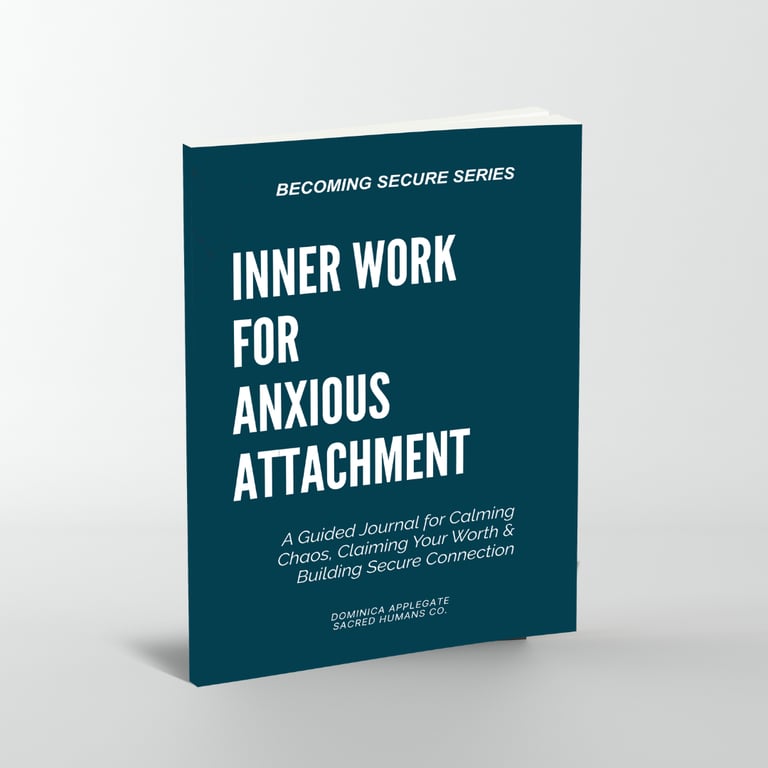
If you want a more structured way to map your attachment triggers and nervous system responses, you can explore the Anxious Attachment Guided Journal or schedule an Attachment Mapping Intensive.
This work isn’t about fixing yourself.
It’s about understanding what your body learned and teaching it something steadier.
Sources
Bowlby, J. (1969). Attachment and Loss: Volume I. Attachment. New York: Basic Books.
Ainsworth, M. D. S., Blehar, M. C., Waters, E., & Wall, S. (1978). Patterns of Attachment: A Psychological Study of the Strange Situation. Hillsdale, NJ: Erlbaum.
American Psychological Association. (n.d.). Attachment theory. Retrieved from https://www.apa.org
Cleveland Clinic. (n.d.). Fight-or-flight response. Retrieved from https://my.clevelandclinic.org
Harvard Health Publishing. (n.d.). Understanding the stress response.
Mikulincer, M., & Shaver, P. R. (2016). Attachment in Adulthood: Structure, Dynamics, and Change. New York: Guilford Press.