Fearful Avoidant Attachment: Signs, Nervous System Patterns & How to Heal


Quick Answer:
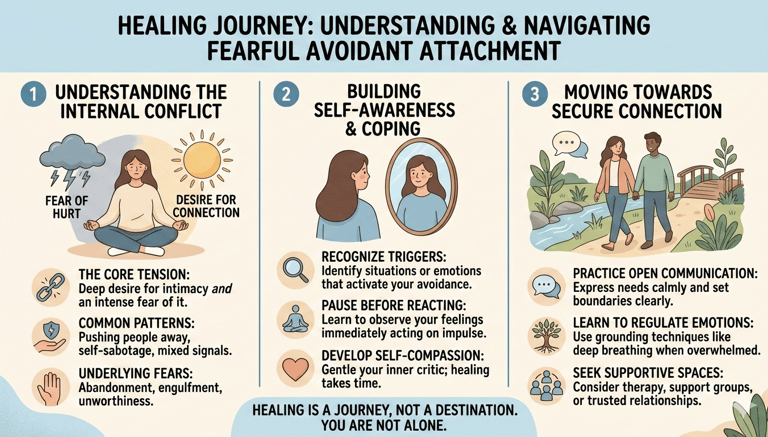
Fearful avoidant attachment (also called disorganized attachment) is an insecure attachment style where the desire for closeness and the fear of closeness exist simultaneously. It develops when early caregiving is both comforting and stressful, training the nervous system to hold two opposing survival strategies — move toward connection and protect yourself from connection — at the same time. In adult relationships, this creates a push-pull cycle of pursuing and withdrawing that can feel confusing and exhausting.
You want closeness. You also fear it.
When someone pulls away, you feel anxious and unsettled. When they move closer, you feel overwhelmed and need space. The same relationship can make you feel desperate for connection one week and suffocated the next.
This is not inconsistency in your character. It is a nervous system conflict.
Fearful avoidant attachment, sometimes called disorganized attachment, develops when early relationships felt both safe and stressful. As a result, your system learned two opposite survival strategies at the same time. Move toward connection. Protect yourself from connection.
In adult relationships, that wiring can create a push-pull cycle that feels confusing and exhausting. Understanding how this pattern works in the body is the first step toward stabilizing it.
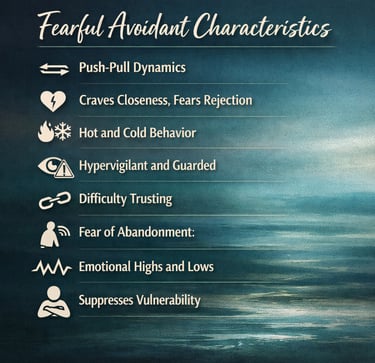
What Is Fearful Avoidant Attachment?
Fearful avoidant attachment, sometimes called disorganized attachment, is a pattern where the desire for connection and the fear of connection exist at the same time.
Unlike anxious attachment, which primarily moves toward closeness, or avoidant attachment, which primarily moves away from it, fearful avoidant attachment does both. The nervous system does not settle into one strategy. It switches.
You may deeply want intimacy. You may imagine a stable, emotionally connected relationship. But when that connection becomes real, something in you feels exposed. Vulnerable. Unsafe.
For example, you might spend days worrying that someone is losing interest. You text, you seek reassurance, you feel relief when they respond. Then, once things feel steady again, you suddenly feel trapped. You question whether you even want this. You pull back.
This is not manipulation. It is nervous system instability around closeness.
At its core, fearful avoidant attachment is about conflicting survival strategies. One part of you believes connection is necessary for safety. Another part believes connection increases risk.
Both parts are trying to protect you.
How Fearful Avoidant Attachment Forms
Fearful avoidant attachment often develops in environments where love and stress were intertwined.
In early childhood, the attachment figure is supposed to be the source of comfort and safety. But if that same caregiver was unpredictable, emotionally volatile, neglectful, or frightening at times, the nervous system received mixed signals.
Come closer.
Be careful.
A child in this environment cannot fully move toward or fully move away. They need connection to survive, but connection also feels destabilizing. The nervous system does not know which strategy will keep them safest.
Over time, this confusion becomes wired.
Instead of learning that closeness equals safety, the system learns that closeness equals both comfort and danger. That conflict does not disappear in adulthood. It shows up in romantic relationships, friendships, and even work dynamics.
For example, you might feel intense attraction to someone who feels emotionally unavailable. The distance feels familiar. When someone is consistently available and emotionally steady, you may feel less intensity. Stability can feel unfamiliar and, at times, uncomfortable.
This does not mean you prefer chaos. It means your nervous system is calibrated around unpredictability.
Understanding this origin is important. Fearful avoidant attachment is not about being dramatic or indecisive. It is about a nervous system that learned two opposing rules about love.
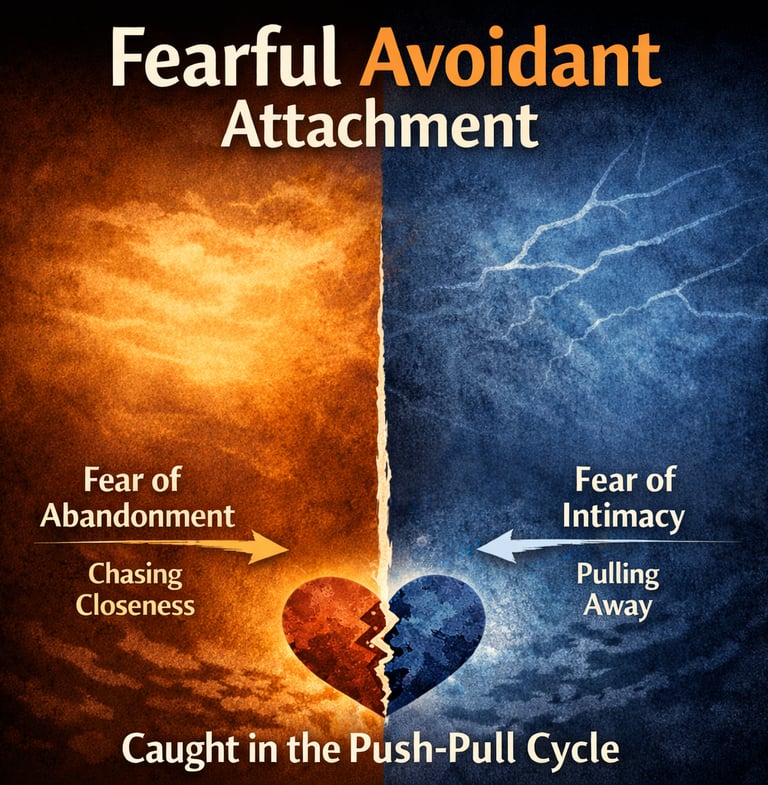
The Fearful Avoidant Nervous System Explained
To understand fearful avoidant attachment, you have to understand what is happening underneath the behavior.
This pattern is not just emotional. It is physiological.
Fearful avoidant attachment combines two nervous system responses: hyperactivation and deactivation. At different moments, your body can move into alarm or shutdown.
When you sense distance, your system may move into hyperactivation. Your heart rate increases. Your thoughts speed up. You replay conversations. You worry you are about to be abandoned. You feel urgency to fix the connection.
But when someone moves closer or expresses deeper commitment, your system can flip. The intensity of closeness raises internal arousal. Instead of leaning in, your body shifts toward deactivation. You feel numb. Irritated. Detached. You need space.
This switch can happen quickly.
For example, imagine your partner has been distant for a few days. You feel anxious and preoccupied. You want reassurance. Then they open up and say they want to work on the relationship. Suddenly, instead of relief, you feel pressure. You question your feelings. You feel the urge to withdraw.
This is not indecision. It is a nervous system that does not feel fully safe in either position.
Closeness activates vulnerability. Distance activates abandonment fear. The body moves back and forth trying to reduce discomfort.
Until you recognize the pattern, it can feel like your emotions are unreliable. In reality, your nervous system is trying to regulate itself using two opposite strategies.
The Push-Pull Cycle in Relationships
Because the fearful avoidant nervous system swings between activation and shutdown, relationships can feel unstable.
The cycle often follows a predictable pattern.
At first, there is attraction and intensity. You feel drawn in. You open up. Connection builds. As emotional closeness increases, you begin to feel exposed. You may start noticing flaws. You create space. The other person feels the shift.
If they pull back in response, your anxiety rises again. Now you feel the loss of connection. You move toward them. You seek closeness. When they respond and move closer again, the cycle repeats.
This push-pull dynamic can be confusing for both partners. One moment you seem deeply invested. The next, distant and unsure.
With an anxious partner, this can amplify quickly. Their pursuit may trigger your shutdown. Your distance may intensify their pursuit. Both nervous systems become reactive.
With an avoidant partner, the dynamic can look different. Their withdrawal may trigger your anxiety. But once they move closer, your own shutdown can appear.
Over time, this instability can create exhaustion. You may question whether you are capable of stable love. You may assume something is fundamentally wrong with you or the relationship.
But the instability is not random.
It is the result of a nervous system that never fully learned that connection can be both safe and steady at the same time.
Body Cues of Fearful Avoidant Attachment
Fearful avoidant attachment is not just a pattern of behavior. It is a pattern of state shifts in the body.
If you pay attention closely, you can often tell which direction your nervous system is moving before you act on it.
During hyperactivation, the signs look similar to anxious attachment. Your chest may feel tight. Your stomach unsettled. You check your phone repeatedly. Your thoughts become focused on the relationship. You may replay conversations and imagine worst-case outcomes. There is urgency in your body.
Then the shift can happen.
During deactivation, the intensity drops suddenly. You may feel heavy or emotionally flat. Instead of racing thoughts, you feel foggy. You might think, Maybe I do not care that much. Maybe this is not right. You feel the desire to pull away, cancel plans, or emotionally detach.
The confusing part is how fast the switch can occur.
You can move from missing someone intensely to questioning the entire relationship within a short time frame. It can feel like your feelings are unreliable. In reality, your nervous system is cycling between two regulation strategies.
Recognizing these body cues is important. If you can identify whether you are in activation or shutdown, you can pause before making permanent decisions from a temporary state.
Regulation for Fearful Avoidant Attachment
Stability does not come from choosing anxiety over avoidance or avoidance over anxiety. It comes from learning to regulate both states. The goal is not to eliminate your reactions. It is to interrupt the automatic swing between them.
Here is how to approach it step by step.
Step 1: Track Your State Shifts
Before you change anything, you need awareness. Notice when you feel anxious and when you feel detached. These are different nervous system states. One feels urgent and intense. The other feels numb or distant.
Ask yourself:
Am I feeling urgency right now?
Or am I feeling numbness?
You can write this down if it helps. A simple note like “activated” or “shutting down” builds pattern recognition. Labeling the state reduces its power. When you name it, you create a pause between feeling and reacting.
Step 2: Regulate Hyperactivation
If you notice urgency, racing thoughts, or fear of abandonment, your system is likely in hyperactivation.
In this state, your job is to slow the body before you act.
Lengthen your exhale. A longer exhale helps calm the nervous system.
Press your feet firmly into the floor and notice the pressure.
Delay reactive messages or decisions.
You are not trying to erase anxiety. You are lowering the intensity so you can respond instead of react.
Step 3: Interrupt Deactivation
If you notice numbness, irritation, or the urge to disappear emotionally, you are likely in deactivation.
In this state, do the opposite of withdrawal.
Stay present in the conversation a few minutes longer.
Notice physical sensations in your body instead of mentally checking out.
Speak one honest sentence about what you are feeling, even if it is simple.
You do not need to force deep vulnerability. The goal is to prevent full shutdown.
Step 4: Delay Major Decisions
Fearful avoidant attachment often leads to impulsive endings during activation or shutdown.
Create a rule for yourself. Do not make major relationship decisions while in a heightened state. Give your nervous system time to settle. What feels urgent today may feel different tomorrow.
Step 5: Practice Tolerating Discomfort
Over time, this process builds capacity.
Instead of swinging between panic and withdrawal, you begin to experience discomfort without immediate reaction. The cycle shortens. The intensity decreases.
Progress is subtle. It looks like:
Shorter emotional spikes
Fewer abrupt withdrawals
Clearer communication
Less regret after conflict
Fearful avoidant attachment can become more secure. The nervous system can learn that closeness does not automatically lead to harm and distance does not automatically mean abandonment.
That shift does not happen overnight. It happens through repetition, patience, and steady awareness.
Can Fearful Avoidant Attachment Become Secure?
Yes. But the change does not happen by choosing one side of yourself over the other.
Security develops when the nervous system no longer has to swing between alarm and shutdown to feel stable. It happens when closeness does not automatically trigger overwhelm and distance does not automatically trigger panic.
This shift is gradual.
At first, progress looks small. You pause before sending a reactive message. You stay in a difficult conversation a few minutes longer. You wait before ending a relationship when your feelings suddenly drop. You begin asking, “Am I activated or shutting down right now?” instead of assuming your emotions are facts.
Over time, the swings shorten. The intensity softens. You still feel desire for connection. You still value independence. The difference is that those needs stop feeling mutually exclusive.
Secure attachment does not erase sensitivity. It stabilizes it.
Instead of chasing then withdrawing, you learn to tolerate moderate discomfort. You communicate more directly. You choose closeness intentionally rather than reacting to fear.
This is nervous system learning. And nervous systems can change with repetition and safe relational experiences.
Frequently Asked Questions
Why do I push people away when I love them?
Because closeness activates vulnerability. If your nervous system associates vulnerability with risk, it may trigger deactivation to reduce overwhelm. The withdrawal is protective, not proof that you do not care.
Is fearful avoidant the same as disorganized attachment?
In adult attachment theory, fearful avoidant and disorganized attachment are often used interchangeably. Both describe a pattern where the nervous system holds conflicting responses to closeness.
Why do I feel calm after ending a relationship?
Ending a relationship can reduce internal activation. The nervous system may settle once uncertainty is removed. That calm does not necessarily mean the relationship was wrong. It may mean your body is relieved from the stress of emotional intensity.
Can fearful avoidant attachment change?
Yes. With awareness, regulation practice, and consistent relational experiences that feel stable rather than chaotic, the nervous system can learn that connection is not inherently dangerous.
Why do relationships feel chaotic to me?
Because your nervous system may be shifting rapidly between hyperactivation and shutdown. The external relationship may not be chaotic, but your internal state changes create instability.
Am I toxic if I’m fearful avoidant?
No. Fearful avoidant attachment reflects adaptation to early relational stress. It becomes harmful only when it goes unexamined. With awareness and practice, the pattern can become more secure.
If you see yourself in this description, remember that the push-pull cycle is not your identity. It is a nervous system pattern.
Patterns can be understood. And understood patterns can be changed.
References
Ainsworth, M. D. S., Blehar, M. C., Waters, E., & Wall, S. (1978). Patterns of attachment: A psychological study of the strange situation. Lawrence Erlbaum.
Bowlby, J. (1969). Attachment and loss: Vol. 1. Attachment. Basic Books.
Main, M., & Solomon, J. (1990). Procedures for identifying infants as disorganized/disoriented during the Ainsworth Strange Situation. In M. T. Greenberg, D. Cicchetti, & E. M. Cummings (Eds.), Attachment in the preschool years (pp. 121–160). University of Chicago Press.
Mikulincer, M., & Shaver, P. R. (2007). Attachment in adulthood: Structure, dynamics, and change. Guilford Press.
Eisenberger, N. I., Lieberman, M. D., & Williams, K. D. (2003). Does rejection hurt? An fMRI study of social exclusion. Science, 302(5643), 290–292. https://doi.org/10.1126/science.1089134
Gross, J. J., & Levenson, R. W. (1997). Hiding feelings: The acute effects of inhibiting negative and positive emotion. Journal of Abnormal Psychology, 106(1), 95–103. https://doi.org/10.1037/0021-843X.106.1.95
Attachment Blueprint
Articles
Anxious Attachment
Avoidant Attachment
Fearful-Avoidant
© 2025. All rights reserved.
EXPLORE
About
Workbook
Contact
Quiz