Why Reassurance Never Feels Like Enough in Anxious Attachment
Sometimes reassurance works for a moment.
You ask if everything is okay. You hear that nothing is wrong. You get the text back, the calm answer, the confirmation you needed, and for a brief moment, your body softens.
Then something shifts.
A pause feels longer than expected. Their tone sounds slightly different. Your mind starts checking whether the reassurance still counts. What helped a few minutes ago suddenly feels fragile again.
This is one of the most confusing parts of anxious attachment reassurance: the comfort can feel real, but it often does not last.
That does not usually happen because the reassurance was false. It happens because reassurance can reach your thoughts faster than it reaches your nervous system. You may understand the words, but your body can still stay alert, scanning for signs that something has changed.
That is why reassurance often fades quickly in anxious attachment. Relief arrives, but uncertainty returns because the system underneath the fear has not fully settled.
Over time, this can create a reassurance anxiety cycle where the mind keeps looking for another moment of certainty, even after clarity was already given.
Understanding why that happens matters, because the goal is not to stop needing reassurance completely. The goal is to understand why reassurance stops holding and what helps your body stay with safety longer when it does appear.
Why An Anxious Nervous System Struggled to Hold Reassurance
Reassurance often gives the mind an answer before the body feels safe enough to believe it.
That is why someone can hear, “We’re okay,” agree with it logically, and still feel unsettled a few minutes later. The words make sense, but the nervous system may still be waiting for proof that the moment is truly stable.
When anxious attachment is active, the body does not only respond to what is said. It also pays close attention to tone, timing, facial expression, pauses, and any small change that could suggest distance. A calm answer can still feel incomplete if the body remains alert.
This is why reassurance often fades quickly. The first wave of relief comes from having uncertainty reduced, but if the nervous system is still scanning for threat, that relief does not last long.
A short delay in the next message can suddenly feel important. A neutral expression can seem harder to read. The mind starts checking whether the reassurance still applies or whether something changed after it was given.
In that state, the problem is rarely a lack of information. More often, it is that the body has not fully registered safety yet.
For many people, this happens because earlier relationship experiences taught the nervous system that connection can shift without warning. Even when reassurance is sincere, the body may still expect inconsistency and continue searching for signs that certainty could disappear.
That is why reassurance can feel helpful and unstable at the same time. The words arrive, but the nervous system may still be waiting for enough repeated calm to believe they will hold.

The Reassurance Anxiety Cycle That Keeps Repeating
The difficult part about reassurance is that it often does work for a moment.
A reply comes through. The answer sounds clear. The fear drops enough for your body to loosen slightly, and for a short time it feels like the situation is under control again.
Then the calm starts to fade.
Nothing major may have changed, but the mind begins looking again. A message gets reread. A small pause feels noticeable. The original reassurance starts to feel less certain than it did a few minutes earlier.
This is how the reassurance anxiety cycle forms.
It usually follows the same sequence:
discomfort appears
uncertainty starts building
reassurance is sought
relief arrives briefly
doubt returns
another form of reassurance starts to feel necessary
Because the relief is real, even if it is short, the brain quickly learns that reassurance can reduce distress. That makes it easy to reach for again the next time anxiety rises.
Over time, the pattern can become automatic.
The nervous system begins to expect external confirmation whenever uncertainty appears, even when there is no new evidence that something is wrong.
This is why anxious attachment needing reassurance can start to feel urgent rather than optional. The body is not simply asking for comfort. It is trying to restore internal stability as quickly as possible.
The problem is that repeated reassurance often calms the immediate fear without changing the underlying sensitivity that keeps producing it.
That is why reassurance can start to feel strangely unsatisfying. You may get the answer you needed, but still feel pulled to check again because the calm never fully settles into something durable.
Many people notice this and assume they are asking for too much.
More often, what they are noticing is a nervous system that has learned to trust short relief more easily than lasting safety.
Reassurance is Not Always Asking Directly
Many reassurance habits do not sound like reassurance when they happen.
They often appear as small checks that seem reasonable in the moment, especially when anxiety has already started building. Because the fear usually feels tied to something subtle, the response often becomes subtle too.
A person may not directly ask, “Are we okay?” but still look for the answer in other ways.
Common examples include:
rereading old messages to check whether warmth has changed
asking a different question just to hear the other person’s tone
bringing up something small to test how engaged they sound
checking whether a reply feels shorter than usual
watching for changes in punctuation, speed, or wording
noticing whether affection appears without being asked for
These behaviors often happen quickly and quietly.
They can feel like observation, but underneath them is the same goal. The mind is trying to decide whether connection still feels secure.
This is why anxious attachment emotional dependence does not always look dramatic from the outside. Often it looks like constant internal checking that never fully reaches rest.
The difficulty is that these checks rarely create lasting calm.
A message may sound warm, but then attention shifts to how long the next reply takes. A reassuring answer may help, but then the mind notices that the wording felt slightly different than before.
The search for certainty keeps moving because the nervous system is still trying to solve something deeper than the moment itself.
It is trying to answer whether safety is stable enough to trust without constant monitoring.
That is why reassurance can become exhausting even when it stays mostly invisible.
The behavior may look small, but internally it can keep attention locked onto connection all day, waiting for enough evidence to finally feel settled.
Why Reassurance Can Start Feeling Embarrassing
Many people notice the pattern before they know how to change it.
They hear themselves asking again, or feel the urge to check one more time, while another part of them already knows they asked recently. That creates a second layer of discomfort. There is the original anxiety, and then there is the awareness that reassurance is becoming difficult to trust.
This is often where embarrassment appears.
The fear itself still feels real, but the need to keep returning to the same point can create thoughts like:
I should be over this by now
They already answered me
Why am I still thinking about it
I do not want to sound needy
What if they get tired of this
Relief and shame often arrive together.
A reassuring answer can calm the fear briefly while also creating worry about how often reassurance is needed in the first place. That can make the next request feel heavier, even before it is spoken.
For many people, this is the moment where anxious attachment starts feeling personal in a painful way. The concern is no longer only about whether something is wrong in the relationship. It becomes concern about what repeated reassurance might mean about them.
What often goes unspoken is that the deeper fear is not simply being misunderstood. It is becoming emotionally exhausting to someone important.
That is why reassurance can feel so emotionally loaded. The person is not only trying to settle uncertainty. They are also trying to avoid confirming the fear that their needs are too much.
This matters because shame usually makes the cycle stronger, not weaker.
When reassurance starts feeling embarrassing, people often become more internal and more watchful. They ask less directly, but monitor more closely. They try to appear calmer while feeling even more activated underneath.
The outside may look quieter, but the nervous system is often working even harder to find certainty without having to ask for it.
Why Reassurance Can Stop Helping Even When Your Partner Responds Well
One of the most confusing parts of this pattern is that reassurance can stop working even in a caring relationship.
A partner may answer clearly, respond consistently, and try to offer comfort in good faith, yet the anxiety still returns. This often leads people to wonder whether they are asking for something impossible, or whether something deeper is wrong that reassurance cannot reach.
In many cases, the issue is not the quality of the reassurance. It is that reassurance cannot fully settle a nervous system that is still expecting instability.
A kind answer may create temporary calm, but if the body remains alert, attention quickly shifts back toward what might have changed since that answer was given.
That is why even supportive reassurance can start losing strength over time.
The nervous system may continue asking questions such as:
Does that answer still apply now
Did their tone change afterward
Are they reassuring me because they mean it or because they want to end the conversation
What if something changed and I missed it
This can place pressure on the relationship without either person intending it.
The partner may start feeling responsible for creating calm that does not last. The person asking for reassurance may feel frustrated that something kind and genuine still does not fully help.
Over time, both people can begin reacting to the pattern rather than the original fear.
That is why the goal is not to eliminate reassurance completely. Healthy reassurance has a place in close relationships. The difference is whether reassurance supports connection or becomes the main way the nervous system tries to regulate uncertainty.
Healthy reassurance usually settles after clarity is given.
When reassurance fades quickly, the body often needs something else alongside words.
What helps most is learning to notice activation before immediately reaching for another answer.
That may include:
noticing physical tension before asking again
waiting briefly before checking for more certainty
asking what changed externally versus what shifted internally
allowing discomfort to exist without immediately solving it
This does not mean ignoring your needs.
It means building the ability to stay present long enough for safety to register more fully.
Lasting change usually happens through repetition.
When the body experiences uncertainty without immediate escalation, it slowly learns that discomfort does not always mean connection is collapsing. Over time, reassurance can begin to feel less urgent because internal stability becomes stronger.
The goal is not to stop caring about reassurance.
It is to stop relying on reassurance as the only thing that makes safety feel believable.
Why Change Starts with Tolerating a Little More Uncertainty
Anxious attachment often creates urgency because uncertainty feels like something that must be solved immediately.
That is why reassurance can feel necessary even when you understand the pattern. The mind wants certainty, but the deeper work is helping the body stay present before certainty arrives.
Change usually starts in small moments.
A pause before asking again. A decision not to reread the message immediately. A few extra minutes without checking whether something shifted.
Those moments matter because they teach the nervous system that discomfort does not always mean something is wrong.
Over time, that repetition helps reassurance last longer.
The goal is not to stop needing reassurance altogether. It is to build enough internal steadiness that reassurance supports calm instead of carrying all of it.
Working Toward Secure, Healthy Relationships
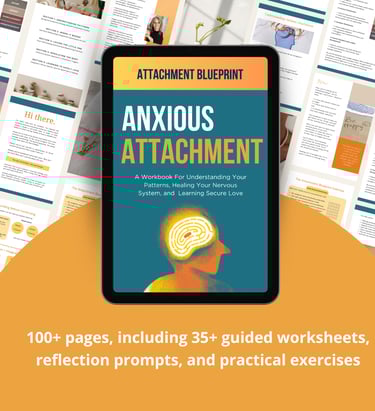
Because insight alone is often not enough, we created a digital workbook designed for the moments anxious attachment actually shows up.
Inside the workbook:
downloadable digital format
fillable pages you can type into or print
guided nervous system exercises
trigger mapping worksheets
reflection prompts for relationships
communication and reassurance patterns
grounding tools for anxious moments
practical exercises you can return to anytime
It is built for people who understand the theory but still need something steady in real moments.
Attachment Blueprint
Articles
Anxious Attachment
Avoidant Attachment
Fearful-Avoidant
© 2025. All rights reserved.
EXPLORE
About
Workbook
Contact
Quiz