Anxious Attachment Workbook: What Actually Helps Between Triggers
Between triggers is where anxious attachment actually changes. Here's what helps and how a structured anxious attachment workbook supports the process.
You already know you have anxious attachment. You've probably read about it, maybe talked about it in therapy, maybe spent more time than you'd like understanding why you react the way you do. The childhood part. The nervous system part. The pattern that shows up, reliably, every time connection feels uncertain.
And then a trigger happens. A delayed reply. A flat tone. A moment where something shifts, barely perceptibly, and suddenly everything you understand about yourself disappears and the feeling is all there is. The spiral starts. The old urgency arrives. And you're back in it, again.
That gap... between understanding your pattern and being able to respond differently inside of it... is where this article lives. Most attachment content explains the pattern. Very little explains what to actually do on a Tuesday afternoon between the last trigger and the next one. That's what this is about.
Key Terms: What These Words Actually Mean
Anxious attachment - An insecure attachment pattern marked by fear of abandonment, hypervigilance in relationships, and a strong need for reassurance. Develops when early caregiving was inconsistent or unpredictable.
Trigger - A signal — a delayed reply, a change in tone, silence — that activates the nervous system's threat response before conscious thought arrives.
Between triggers - The window of relative calm between activations. The most important and most underused time for pattern change.
Nervous system regulation - Practices that return the body from a threat state to a calm baseline — not through thinking, but through physical, breath-based, or somatic tools.
Earned secure attachment - Security built deliberately through practice and experience, rather than from a consistently safe early environment. Research shows it is fully achievable.
Anxious attachment workbook - A structured self-guided tool combining trigger mapping, nervous system exercises, and reflection prompts to help change the pattern from the inside out.
Quick Answer
What actually helps anxious attachment between triggers?
The most effective work happens between activations, not during them. This includes mapping your specific triggers before they arrive, learning your body's signal sequence before thoughts form, practicing tolerance of small uncertainties, regulating the nervous system before attempting interpretation, and reflecting on patterns after intensity passes. A structured anxious attachment workbook supports this by providing prompts and exercises that meet you in ordinary moments; not just the calm ones.
Why Understanding Your Pattern Doesn't Stop It
There's a reason you can read every article ever written about anxious attachment and still find yourself spiraling at 11pm over an unreturned message. It's not because the articles are wrong. It's because understanding lives in a different part of the brain than the part that fires when you feel triggered.
The prefrontal cortex - where insight, self-awareness, and rational analysis live - is a slow processor. The nervous system response that anxious attachment runs through is faster. Much faster. By the time your rational mind arrives at the situation, the body has already flooded with urgency. The threat signal is already sounding. The protective behaviors are already loading.
This is why the body reacts before thought catches up and why insight, however deep and accurate, doesn't stop the reaction in real time. Understanding the pattern is the beginning of the work. It is not the work itself.
The work is what happens between triggers. The small, repeated, unglamorous practices that give the nervous system something new to learn from. That's where the pattern actually changes.
Knowing your pattern and being able to respond inside it are two completely different skills. Most people have the first one. The second takes practice.
What 'Between Triggers' Actually Means
Between triggers is not the calm part where nothing is happening. It's every moment that isn't actively on fire... the Tuesday afternoon when you're not in a spiral, the morning after a hard conversation when you feel steadier, the ordinary hour when things feel okay and you're not being tested.
Those moments feel like downtime. They're actually the most important window for real change. Because that's when the nervous system is accessible. When the prefrontal cortex is fully online. When you can work with the pattern rather than just survive it.
Most people spend that window either recovering from the last trigger or quietly bracing for the next one. The nervous system stays in a low hum of alertness even when nothing is actively wrong. Which is its own kind of exhausting. And it means the between-trigger window... the one that could be used to actually shift the pattern... gets spent on vigilance instead.
What changes that hum, slowly and steadily, is using this window with intention. Not obsessively. Not as another form of anxious work. But with the quiet, practiced attention that says: I'm going to understand this pattern more clearly so that next time, I have something to work with.
The Difference Between Coping and Actually Changing
Most anxiety management advice is coping advice. Breathe through it. Ground yourself. Call a friend. Distract yourself until it passes. And coping is useful... genuinely, in the moment, it matters. But coping and changing are not the same thing, and conflating them is one of the main reasons people can spend years managing anxious attachment without it getting meaningfully smaller.
Coping gets you through. Changing means the next trigger is a little less intense. The spiral is a little shorter. The recovery time is a little faster. The gap between the trigger and your response grows just wide enough for a choice to live in it.
Coping - Gets you through the moment
Changing - Shrinks the next moment's intensity
Coping - Manages the reaction after it arrives
Changing -Works on the pattern between triggers
Coping -Feels like relief
Changing -Feels like slow, quiet progress
Both matter. But if you've been coping for years and still find yourself in the same spiral, it's probably because coping has been the entire strategy and the underlying pattern hasn't had a chance to update.
What Actually Helps Between Triggers
These aren't dramatic interventions. They're ordinary, repeatable, nervous-system-level practices — the kind that work precisely because they're not trying to be revelations.
1. Map your triggers before they map you
Most people only think about their triggers while they're inside them. That's the worst possible time to understand anything with clarity. Between triggers, it becomes possible to get curious without urgency: what specifically tends to set the pattern in motion? Is it uncertainty? Silence? A shift in warmth? Being physically alone? A message that sounds different from usual?
When you can name the specific shape of your triggers with some precision — not just "I get anxious," but what exact signal starts it — you begin to see them arriving slightly before they hit. That fraction of a second matters. It's the difference between being swept and noticing the current before you're in it.
2. Learn what your body does before your thoughts arrive
Before any thought forms, the body signals. Most people learn to catch their triggers by noticing the thought... they haven't replied, something's wrong... but the body moved before that. Tightness in the chest. A shift in breath. A drop somewhere in the stomach. A sudden narrowing of attention.
Learning your body's specific sequence is one of the most underrated tools in changing the pattern. Because it gives you an earlier intervention point, before the story is built, before the urgency is fully activated, before the protective behaviors start loading.
This is part of why hypervigilance feels so exhausting... the body is tracking constantly, burning energy on monitoring, and most people don't know it's happening until the alarm is already loud.
3. Practice sitting with small uncertainties
The urge to resolve uncertainty fast - to send the message, ask the question, push for confirmation - is almost unbearable in the middle of a trigger. And acting on it immediately often creates the distance it was trying to prevent. The extra message. The push for reassurance. The behavior that makes sense from inside the fear and looks like pressure from outside it.
Between triggers is when it's possible to practice sitting with a small discomfort intentionally. Not as punishment. As training. Start small; five minutes of not resolving something minor, noticing the discomfort, and watching it pass. That's not suppression. That's building the capacity to choose your response rather than be driven by the urgency.
Because reassurance rarely fixes the underlying system. It soothes the surface and leaves the root untouched. The practice is learning to tolerate uncertainty just a little longer each time, until the nervous system stops treating ambiguity as emergency.
4. Regulate the body before interpreting the situation
The order of operations matters enormously here. When the nervous system is in threat mode, every interpretation it generates is going to be threat-colored. Trying to think your way into a balanced perspective from inside an activated state is like trying to read fine print in a dark room. The tool isn't wrong; the conditions are.
The body needs to settle first. Slow exhales, longer than the inhales. Cold water on the wrists or face. Feet flat on the floor, physical weight noticed. Simple, physical, available anywhere, and they work precisely because they're bypassing the thinking mind and communicating directly with the nervous system.
This is where embodied regulation practices become genuinely practical rather than abstract. They're not wellness habits. They're nervous system tools with a specific job: get the body calm enough that the mind can function properly.
5. Reflect after the trigger, not during it
Once the intensity passes... a few hours later, the next morning... there's a window of unusual clarity. You can look back at what happened with some distance. What triggered it, specifically? Where in the body did it start? What story did the mind build? What did you do in response, and did that help, or make things harder?
That reflection, repeated after each trigger, builds a personal map. And maps make the next journey less disorienting. Over time you start to see the pattern from the outside even while you're inside it, which is when real choice becomes available.
The between-trigger practice, summarized:
→ Notice what your body does before your thoughts arrive
→ Name the specific trigger; not just the feeling, but the exact signal that started it
→ Practice sitting with one small uncertainty for five minutes before acting on the urge to resolve it
→ Regulate the body first; slow exhale, grounding, physical settling before attempting interpretation
→ Reflect after the spiral, not during it; build your personal trigger map over time
→ Return to the map before the next trigger, not only after
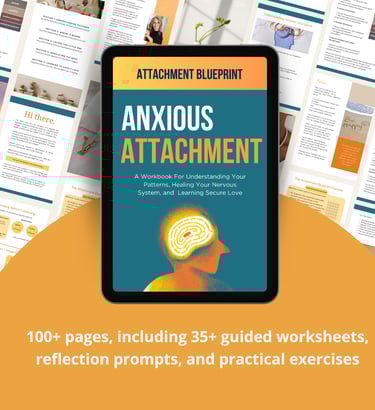
The Attachment Blueprint workbook was built for exactly this space: the gap between understanding your pattern and being able to respond differently inside it. Trigger mapping exercises, nervous system tools, and reflection prompts designed for real moments, not ideal ones.
See what's inside the workbook →
Why Written Reflection Changes Things That Thinking Doesn't
There's something specific that happens when you write something down rather than just think it. The thoughts slow. They become legible. The swirling becomes a sentence — and a sentence can be examined in a way that a feeling spinning in your head cannot.
For anxious attachment specifically, written reflection creates a slight distance between you and the thought. When you write "I felt certain they were pulling away," you can look at that sentence and ask: is that a fact or an interpretation? That question is nearly impossible to ask when the certainty is happening inside you in real time.
A structured workbook does something a blank journal page often can't: it stops the circle at a specific point and asks a specific question. What actually happened, in one sentence? What did my body do before my thoughts arrived? What story did I build, and what evidence do I actually have for it?
Those aren't abstract therapeutic exercises. They're pattern interruptions in written form. And over time, the interruption becomes more automatic. The question starts asking itself, even without the page.
What Consistent Practice Actually Builds
Consistent practice — trigger mapping, body awareness, regulated reflection, practiced pauses — doesn't make you someone who doesn't feel things intensely. It makes you someone whose feelings don't automatically run the show. That's the difference. And it's a meaningful one.
What builds over time isn't numbness or emotional flatness. It's a slightly wider gap between the trigger and the response. A half-second of choice that wasn't there before. The ability to notice the spiral starting and have something to reach for that isn't the old protective behavior — the extra message, the shutdown, the escalation.
What changes with consistent practice:
→ The gap between trigger and response widens — slowly, but it widens
→ Recovery time after a spiral gets shorter
→ Specific triggers become recognizable before they fully activate
→ The body's signals become legible earlier in the sequence
→ Interpretation from a regulated state starts to feel different from interpretation while activated
→ Reassurance-seeking becomes less automatic, more chosen
The nervous system learns through repetition, not revelation. Every time you sit with a small discomfort and it passes without the relationship collapsing, the system updates its prediction slightly. Every time you regulate before interpreting and the interpretation turns out to be less catastrophic than it felt, the pattern loosens a little.
It's not linear. Some weeks feel like regression. Some triggers hit just as hard as they ever did. But the overall trajectory, with consistent practice, is toward something researchers call earned secure attachment — not the security that came from a perfect early environment, but security built deliberately, through practice, one ordinary moment at a time. It is fully achievable. Research is clear on that.
The goal isn't to stop feeling things first. It's to build enough of a gap between the feeling and the response that a choice can live there.
What to Look For in an Anxious Attachment Workbook
Not all workbooks are built the same way. It's worth being specific about what makes one genuinely useful for this kind of work, as opposed to the kind that feels helpful for an afternoon and then sits on a shelf.
A useful anxious attachment workbook should address all four of these areas:
→ Pattern recognition — not just naming the attachment style, but understanding the specific shape of your triggers, your body's response sequence, and the stories your mind builds when activated
→ Nervous system awareness — what's actually happening physiologically during a trigger, and how to work with the body rather than argue with the mind
→ Real-time tools — practices that can be used during or immediately after activation, not only in calm reflection
→ Relational application — how the pattern shows up in actual relationship dynamics: communication, conflict, reassurance-seeking, and recovery after a hard moment
The difference between a workbook that gets used and one that doesn't is usually whether the exercises meet you where you actually are — in the messy, inconvenient, not-at-all-composed moments — rather than only in the ideal headspace where growth feels manageable.
The Attachment Blueprint workbook brings together four areas that shape how you experience love, conflict, and emotional safety: attachment patterns, nervous system response, emotional wounds, and the way the brain repeats what feels familiar. Because real change doesn't happen through insight into one of those things. It happens when all four start to make sense together.
100+ pages. Trigger mapping, nervous system exercises, reflection prompts, communication tools. Digital, instant access, use at your own pace.
Get the Attachment Blueprint workbook →
Frequently Asked Questions
What does an anxious attachment workbook actually help with?
A good anxious attachment workbook helps you understand the specific shape of your triggers, recognize what your body does before your thoughts arrive, practice regulation tools for real moments, and reflect on patterns after they happen. The goal isn't more insight — it's different responses, over time, through practice.
When is the best time to work through an anxious attachment workbook?
Between triggers — not during them. When you're activated, the nervous system isn't in a state where new information integrates well. The most useful window is after a trigger has passed and you've returned to relative steadiness. That's when the nervous system is accessible and the reflective mind is fully online.
Is a workbook enough, or do I need therapy?
A workbook is not a replacement for therapy and it's worth being honest about that. But it is genuinely useful alongside therapy, or for people who aren't currently in therapy. The daily, between-trigger practice happens outside the therapy room regardless — a workbook gives that practice structure.
How long does it take to see results from this kind of work?
Most people notice small shifts — a slightly wider gap between trigger and response, faster recovery after an overthinking spiral — within a few weeks of consistent practice. Deeper pattern change takes longer. The nervous system updates through repetition, not speed.
Why do I keep repeating the same relationship patterns even when I understand them?
Because understanding and nervous system change are processed differently. The part of the brain where insight lives doesn't have direct, real-time access to the part where the triggered response originates. That's not a personal failure. It's neuroscience. Change happens through experience and repetition, not through deeper understanding of the pattern.
Can anxious attachment be healed without therapy?
Yes, though therapy significantly accelerates the process. Healing requires the nervous system to accumulate enough experiences of predicted threat that doesn't materialize — enough moments of bracing that are followed by steadiness rather than collapse. That can happen through consistent self-directed practice, secure relationships, and structured tools. Therapy helps because it provides a safe relational experience in itself. But it isn't the only path.
What is earned secure attachment?
Earned secure attachment is security built through practice and consistent experience, rather than from a safe and predictable early environment. Research shows it is fully achievable in adulthood. It doesn't mean the anxious pattern disappears completely — it means the pattern becomes less automatic, less overwhelming, and less in charge of your responses.
Attachment Blueprint
Articles
Anxious Attachment
Avoidant Attachment
Fearful-Avoidant
© 2025. All rights reserved.
EXPLORE
About
Workbook
Contact
Quiz