Why Anxious Attachment Causes Overthinking
Sometimes it starts with almost nothing. A text lands differently than usual. A reply takes longer than you expected. Someone who normally feels easy to read suddenly feels slightly harder to place, and before anything has actually happened, your mind is already moving faster than the moment deserves.
You reread one sentence. Then another. You notice the tone. You wonder if the tone changed. You tell yourself not to make it a thing, while already making it a thing. That is why waiting can become emotionally louder than the moment itself.
That is what anxious attachment overthinking feels like from the inside. The outside moment can be tiny, almost embarrassingly ordinary, but internally it can hit like a loose wire. One short message can open ten questions. One pause can pull old fear into the room. Your brain starts gathering details like it has been assigned a job: figure out what shifted, figure out what it means, figure it out now before this turns into something worse.
Often, small relationship triggers can feel much bigger than they objectively are, especially when your nervous system already reads uncertainty as important.
The strange part is that it often feels smart while it is happening. Not dramatic. Not irrational. Almost responsible. Like if you think carefully enough, replay enough, catch enough detail early enough, maybe you can stay ahead of hurt. But anxious attachment overthinking is rarely just about thinking too much.
Most of the time, your body notices uncertainty first, then your mind rushes in to explain why you suddenly do not feel steady anymore. And once that loop starts, it can be hard to tell the difference between what is real and what fear is building around what is real. That is also why body-based regulation.
Why Overthinking Starts So Fast in Anxious Attachment
One reason anxious attachment overthinking starts so fast is that uncertainty rarely feels small once your nervous system has noticed it. A reply takes longer than usual, someone sounds slightly off, or their warmth drops just enough for you to feel it before you can explain why. There is often no clean pause between the moment and the reaction. By the time your rational mind catches up, your attention is already locked onto what changed.
That speed can feel unsettling because it makes the whole process seem automatic. One minute nothing is happening, and the next your mind is quietly building theories. Maybe they are upset. Maybe you missed something. Maybe something shifted and you should have seen it sooner. This is often where silence starts carrying more meaning, because the mind does not like empty space when connection suddenly feels uncertain.
People usually judge themselves hard here. They assume they are being dramatic, too sensitive, or making something out of nothing. But most of the time, the mind is doing what it has learned to do when closeness feels unclear: it starts searching. Not because searching always helps, but because uncertainty can feel physically unfinished when attachment is activated.
That search is really an attempt to close an open loop. The brain keeps reaching for something solid, some clue that explains why your body suddenly does not feel steady. And because that search can feel strangely productive, it often disguises itself as emotional intelligence when really it is just fear wearing better clothes.
Why Small Things Turn Into Bigger Stories
The hard part about anxious attachment overthinking is that the mind rarely stays with the original moment. A short reply is no longer just a short reply. It starts connecting itself to yesterday’s tone, last week’s hesitation, that odd pause in conversation you almost forgot until now. Your brain can turn one unfinished moment into a full theory before the other person has even finished whatever they are doing.
A single detail can suddenly feel loaded. The missing emoji. A sentence that sounds flatter than usual. A plan that feels less certain than it did yesterday. None of those things automatically mean something changed, but once your system is activated, small details stop feeling small. That is often when small relationship triggers can quietly start building a much bigger reaction.

What anxious overthinking often sounds like inside your head
Did I miss something?
Why did that feel different?
Maybe I said too much.
Maybe they are pulling away.
I should figure this out before this gets worse.
The mind usually presents these thoughts like they are practical, almost responsible. As if enough analysis might prevent surprise. But most of the time, replay creates more possible meanings, not more clarity.
Why Overthinking Feels Useful Even When It Is Wearing You Out
One reason anxious attachment overthinking is hard to interrupt is that it often feels useful while it is happening. It does not arrive sounding chaotic. It usually arrives sounding practical, almost responsible. Think about it long enough, figure it out early enough, catch the shift before it becomes a problem. That voice can sound so convincing that you do not realize it is pulling you deeper into the same loop.
A lot of people assume overthinking means they are losing perspective, but often it feels more like trying to stay prepared. As if enough analysis could soften whatever hurt might be coming. That is why simple advice like "just stop thinking about it" usually lands badly. The mind is not spinning because it enjoys drama. It is trying to create safety, even if the method is terrible.
Why Overthinking Can Feel Strangely Productive
It creates the feeling that you are doing something
It gives uncertainty a temporary shape
It feels like preparation instead of helplessness
It tricks the mind into believing more thought equals more control
The problem is that mental movement is not the same as emotional steadiness. You can spend an hour replaying one conversation and still feel no closer to calm. Sometimes you actually feel worse, because now there are ten new possibilities to react to instead of one.
That is often when reassurance starts feeling necessary but still does not fully settle the deeper alarm. The mind wants relief, but relief and resolution are not always the same thing.
Why Reassurance Helps but Rarely Solves the Whole Thing
This is usually where reassurance starts to feel like the obvious fix. You ask if everything is okay. You get a kind answer back. The tone softens. For a minute, your whole system loosens. Your breathing changes. Your thoughts stop running quite so hard. It can feel like finally stepping out of noise.
But the relief often does not last as long as you hoped. A little later, sometimes embarrassingly fast, the doubt returns in a different form. They said they were fine, but did they really mean it? Were they just trying not to make this bigger? Why do I still feel unsettled if nothing is wrong? That is where people often start judging themselves, because logically the reassurance should have worked.
The reason it often fades is that reassurance answers the immediate question, but not always the deeper body-level alarm. If your nervous system is still reading uncertainty as unfinished, words may calm the surface without fully settling what is happening underneath. That is why body-based regulation often matters more than trying to collect perfect reassurance.
What reassurance changes and what it does not
That does not mean reassurance is bad. It means reassurance works best when it supports steadiness instead of replacing it. Otherwise the mind keeps going back to the same question, hoping the next answer will finally feel complete.
What Helps When the Spiral Starts
The first helpful shift is noticing that you are trying to solve a feeling with more thinking. That sounds obvious until you are inside it, because anxious thoughts usually arrive dressed as urgency. They do not feel optional. They feel important, immediate, like something needs to be understood right now before you can settle down.
Before asking whether your thought is true, ask something simpler: what changed in me just now? Did your chest tighten? Did your stomach drop? Did your breathing get shallow before the thought even formed? That question often tells the truth faster than the mental story does. A lot of the time, your body reacted first and your mind is trying to explain why after the fact.
When you notice yourself spiraling
Put the phone down before reading the message again
Name one fact instead of five interpretations
Notice what your body is doing before following the thought
Let one unanswered thing stay unanswered for a minute
Wait before asking for more reassurance
The goal is not to force calm or pretend you do not care. It is to slow the speed at which your mind starts building meaning. That is often why waiting can feel harder than it looks from the outside, because the mind wants certainty immediately and the body reads delay like pressure.
Sometimes what helps most is returning to plain facts. What actually happened? What do you know for sure? What are you adding because fear hates blank space? That simple shift can stop one unfinished moment from turning into a full emotional forecast.
Why Certain Situations Hit Harder Than Others
Not every moment triggers the same kind of spiral, and that matters because anxious attachment is often more specific than it first appears. Some situations hit harder because they leave too much room for interpretation. A delayed reply, a changed tone, canceled plans, a conversation that ends without its usual warmth. None of these automatically mean something is wrong, but they all create just enough uncertainty for the mind to start filling space.
What often hits hardest is not conflict. It is inconsistency. Someone who usually sends long messages suddenly sends two words. A person who normally checks in does not. A voice sounds flatter than usual and now your attention is locked there. That is often when silence starts feeling heavier than it objectively is, because the mind notices what is missing before it notices what is still stable.
Common triggers that quietly start the spiral
A reply arrives later than usual
Someone sounds emotionally flatter than normal
A routine changes without explanation
Plans suddenly feel vague
Warmth drops, even slightly
Two people can experience the same moment very differently. One person sees a delayed text and assumes the other person is busy. Another feels a low internal jolt and immediately starts scanning for what changed. The nervous system often reacts less to the event itself and more to what the event resembles emotionally.
How Overthinking Changes Over Time
One of the quieter signs of healing is that your mind stops treating every small shift like proof that something is wrong. You still notice things. You still care. But the reaction loses some of its authority. A delayed reply may still catch your attention, but it does not automatically take over your afternoon.
That change usually happens through repetition, not insight. The nervous system learns slowly that not every pause means distance, not every changed tone means danger, and not every unanswered question needs immediate solving. This is also why body-based regulation usually changes more than trying to argue with every thought.
The Goal Is Not to Think Less
The deeper shift is not becoming less emotional or less observant. It is learning that not every uncomfortable feeling needs immediate interpretation. Sometimes someone is quiet because they are tired. Sometimes a delayed reply is only a delayed reply. Sometimes your mind is trying to build certainty when what you actually need is steadiness.
And steadiness usually grows slowly. Not perfectly, not all at once, but through enough ordinary moments where uncertainty appears and nothing falls apart.
FAQ
Is overthinking always anxious attachment?
No. Anyone can overthink. But anxious attachment often makes relationship uncertainty harder to leave alone because the mind treats unclear moments like something that needs immediate resolution.
Why do I replay conversations for hours?
Because the brain keeps trying to find certainty after something felt emotionally unfinished. It circles the same moment hoping one more pass will finally make it settle.
Why does reassurance wear off so fast?
Because reassurance may calm the immediate thought, while your body still stays alert underneath.
Why does one delayed text affect my whole mood?
Because small changes can feel emotionally loud when connection already feels uncertain. Sometimes the body reacts before the mind even knows why.
Working Toward Secure, Healthy Relationships
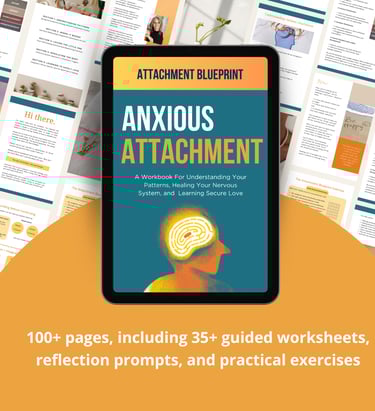
Because insight alone is often not enough, we created a digital workbook designed for the moments anxious attachment actually shows up.
Inside the workbook:
downloadable digital format
fillable pages you can type into or print
guided nervous system exercises
trigger mapping worksheets
reflection prompts for relationships
communication and reassurance patterns
grounding tools for anxious moments
practical exercises you can return to anytime
It is built for people who understand the theory but still need something steady in real moments.

Attachment Blueprint
Articles
Anxious Attachment
Avoidant Attachment
Fearful-Avoidant
© 2025. All rights reserved.
EXPLORE
About
Workbook
Contact
Quiz