Why Hypervigilance Happens in Anxious Attachment
Why one small shift can feel louder than the whole room.
Sometimes nothing has actually happened. Nothing you could explain out loud, anyway, without sounding like you're building a court case with zero evidence.
A text comes in and the wording feels slightly off. Someone says "I'm fine," but their face seems half a second slower than usual. A voice you know well sounds flatter, thinner, less open, and suddenly your attention sharpens like someone turned up the brightness in the room. Not because there's proof. Because something in you noticed a shift before your mind had language for it.
That's what hypervigilance feels like in anxious attachment. It doesn't arrive dramatically. It's subtle, almost annoyingly subtle. Your body picks up something tiny, and then your mind shows up five seconds later asking why your chest feels tight over what should have been an ordinary moment.
Your nervous system is acting like it heard glass break in another room. Meanwhile, the other person is looking for their charger.
And that's part of why it's so exhausting. You can look completely fine on the outside while internally running seventeen open tabs, comparing tone patterns from Tuesday.
Why Hypervigilance Starts So Fast in Anxious Attachment
Anxious attachment doesn't wait for certainty. It reacts to possibility. A small pause, a slight drop in warmth, a delayed answer, and your system starts paying close attention before there's anything solid enough to call a problem.
That speed feels strange because it happens underneath thought. You don't decide to scan the interaction for hidden meaning. Your body gets there first. Stomach tightens. Breathing shifts. Attention narrows. Then the mind arrives and starts trying to explain why you're suddenly on edge.
This is where people get hard on themselves. They think they're overreacting, being too sensitive, making too much of too little. But a lot of the time, your nervous system is doing exactly what it learned to do when connection felt uncertain: it starts tracking. Not because tracking always helps, but because staying alert started to feel safer than staying relaxed.
That's also why small changes can feel emotionally louder than they are - hypervigilance doesn't usually begin with a major event. It begins with one detail your body quietly decides might matter.
What Hypervigilance Actually Looks Like in Real Life
The word itself sounds clinical. Like something that belongs in a textbook next to diagrams nobody asked for. But in real life it looks much less official and much more familiar.
It looks like rereading a message because one word suddenly feels suspicious. Noticing someone used a period instead of an exclamation point and immediately wondering if the emotional weather has changed. Hearing "talk later" and somehow finding twelve possible meanings hiding inside two ordinary words. Which, honestly, is a lot of pressure to put on punctuation.
→ Watching response times more closely than you mean to
→ Noticing tiny changes in tone before anything is said directly
→ Tracking warmth, distance, or hesitation mid-conversation
→ Feeling uneasy before you can explain what exactly feels off
→ Mentally revisiting one moment because it still feels unfinished
The hard part is that this can feel like paying attention, not anxiety. It can even feel smart. Like you're catching details other people miss. But hypervigilance doesn't just notice details. It assigns urgency to them very quickly, and that's where the exhaustion

Why Small Changes Feel Bigger Than They Are
A shorter reply is still just a shorter reply. But hypervigilance rarely lets it stay that simple. The mind starts connecting it to other things. Yesterday they sounded warmer. Last week they answered faster. Earlier today something felt slightly off, maybe. Suddenly one small detail has company, and your brain is building a pattern out of fragments.
And here's where the nervous system gets sneaky: once your body is alert, neutral explanations become weirdly hard to trust. Maybe they're busy. Maybe they're tired. Maybe they're distracted. Sure. But the mind tends to reach first for the explanation that feels protective, even when that explanation also makes you miserable.
That's why silence can start carrying more weight than it actually holds. Once your system starts scanning, even ordinary pauses can begin to feel like they contain information you urgently need to decode.
Why Hypervigilance Can Feel Like Intuition (Even When It's Not)
One reason hypervigilance is hard to catch is that it rarely introduces itself as fear. It sounds much more convincing than that. It sounds observant. Sharp. Almost wise. Like you're simply noticing what other people miss - which, honestly, would be flattering if it weren't so exhausting.
Sometimes it even feels like instinct. You pick up on a tiny shift and immediately think: no, something is different. And to be fair, sometimes something is. People do change tone. Energy does shift. The problem is that hypervigilance doesn't stop at noticing. It keeps going. Checking. Comparing. Scanning for proof. Then scanning again because the first round didn't create enough certainty.
Intuition arrives clear, then sits quietly. Hypervigilance arrives with urgency and keeps asking follow-up questions like an unpaid investigator who refuses to clock out.
Why Hypervigilance Gets So Tiring in Relationships
There is a particular kind of tired that comes from being slightly on alert around someone you care about. Not dramatic panic. Just that constant low-level monitoring, like part of your attention never fully sits down.
You're listening to words, but also tone. Watching expression, but also timing. Tracking what was said, what wasn't said, how long the pause lasted before they answered. Meanwhile the conversation is still happening, and half your brain is analyzing while the other half is trying to look normal. It's a terrible split-screen arrangement.
Hypervigilance can quietly steal ease from connection. You may deeply want closeness while feeling unable to stop scanning the closeness for signs it might shift. That is exhausting for you long before anyone else even knows it's happening.
→ You replay harmless conversations later, still looking for something
→ You notice small changes and can't quite let them go
→ Relaxing feels harder when someone feels emotionally unclear
→ Your body stays tense even after reassurance
That last one matters. Reassurance can soften fear without fully stopping the internal scanning, which is its own kind of frustrating loop.
What Actually Helps When Your System Stays on Alert
The first useful move is not trying to argue with every thought. That usually just turns into another form of scanning. Instead, notice whether your body already reacted before your mind built a story. Did your shoulders tighten? Did your stomach drop? Did your breathing shift because one sentence felt different?
That matters because hypervigilance often loses some of its power when you catch it early enough to name what's happening: my body noticed something, and now my mind is trying to outrun uncertainty. Even saying that internally can interrupt the automatic rush toward meaning.
→ Pause before rereading the message again
→ Name one fact before adding interpretation
→ Let one unanswered thing stay unanswered, briefly
→ Notice whether your body is tense before reaching for reassurance
→ Come back to what's actually happening right now
This is where body-based regulation tends to help more than trying to think your way into calm. Once the body settles a little, the mind usually stops acting like every pause needs a full explanation.
How Hypervigilance Softens Over Time
Healing doesn't mean you stop noticing things. You still notice tone. You still catch changes. You're still perceptive. The difference is that every small shift stops feeling like something you must immediately solve.
A delayed reply may still catch your attention, but it no longer becomes the center of your afternoon. A strange tone may still register, but it doesn't instantly pull ten old fears into the room. That change usually happens slowly, through repetition, not because one day you finally understand yourself perfectly.
The nervous system learns in ordinary moments. Enough moments where uncertainty appears and nothing collapses. Enough moments where you feel the urge to scan, but don't fully hand it authority. Which is less glamorous than people want healing to be, but honestly, most real change is weirdly ordinary.
Over time, your attention starts doing something new. It notices a shift, then waits. It doesn't sprint ahead. It just lets the moment be a moment a little longer than before. And that turns out to be a bigger kind of peace than most people expect.
Frequently Asked Questions
Why do I notice tiny changes so quickly?
Anxious attachment often trains the nervous system to treat subtle shifts in connection as important very early. Your body learned that staying alert felt safer than being caught off guard.
Is hypervigilance always anxiety?
Not always. But when noticing turns into repeated scanning, urgency, and mental checking that you can't switch off, anxiety is usually involved.
Why do I feel so tired after ordinary conversations?
Because constant internal monitoring uses real energy, even when nothing obvious is wrong on the outside. Running two tracks simultaneously is genuinely draining.
Can hypervigilance actually get better?
Yes. Usually through repeated moments where uncertainty happens and your system slowly learns it doesn't need immediate protection every time. It's not a single breakthrough. It's a slow accumulation of ordinary safe moments.
What's the difference between being observant and hypervigilant?
Observant means you notice, then let it settle. Hypervigilant means you notice, then keep looking for confirmation, reassurance, or proof. The first is a skill. The second is your nervous system stuck in protective mode.
Working Toward Secure, Healthy Relationships
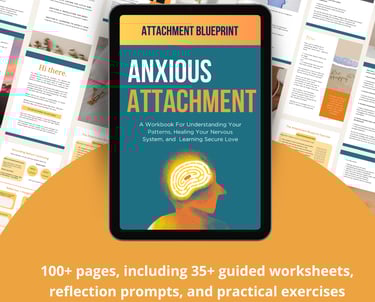
If your body keeps scanning for threats even when nothing's wrong, this workbook has a nervous system reset section
built specifically for that loop.
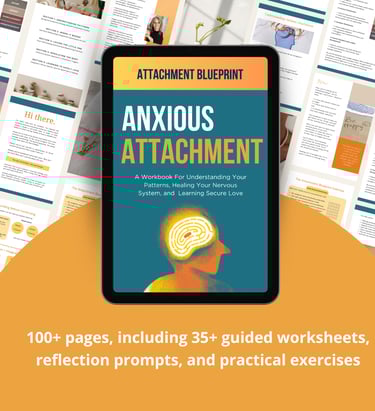
Inside the workbook:
downloadable digital format
fillable pages you can type into or print
guided nervous system exercises
trigger mapping worksheets
reflection prompts for relationships
communication and reassurance patterns
grounding tools for anxious moments
practical exercises you can return to anytime
It is built for people who understand the theory but still need something steady in real moments.
Attachment Blueprint
Articles
Anxious Attachment
Avoidant Attachment
Fearful-Avoidant
© 2025. All rights reserved.
EXPLORE
About
Workbook
Contact
Quiz